Azul Reflections from UNOC3: Day 1 Updates: “The Ocean Turns Blue Without the Stars and Stripes”
RELATED ARTICLES
• Mid-week Reflections from UNOC3: “Counting Fish to Catch Cash? Rethinking Ocean Finance Before It’s Too Late”
• End-of-week Reflections from UNOC3: “The Ocean Is Not an ATM: Transforming Ocean Finance Before We Hit Overdraft”
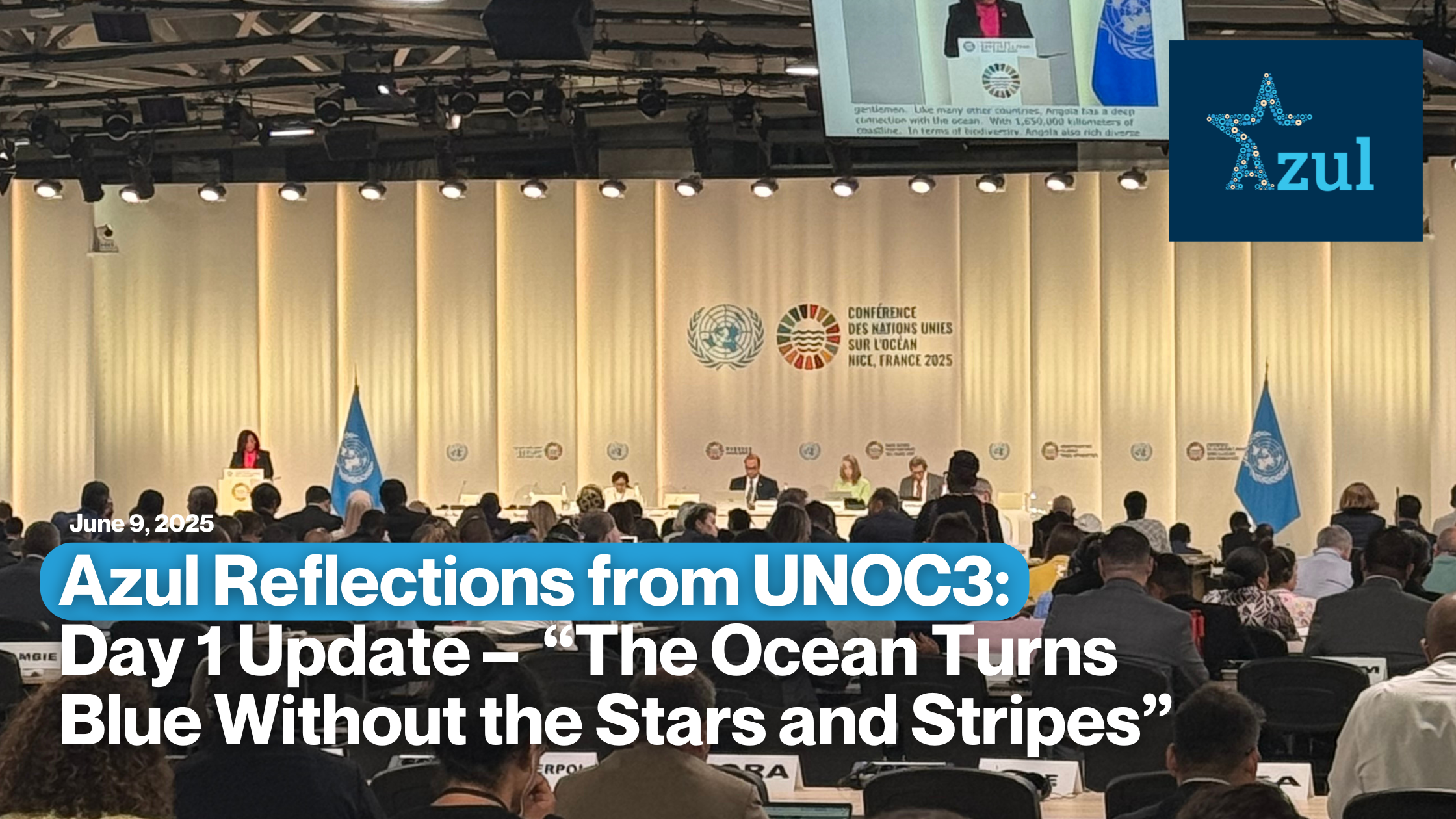
The first day of the Third United Nations Ocean Conference marked a pivotal moment in the global governance of our ocean — a day that may be remembered as the one when the world was forced to begin looking past the United States for leadership in marine science and ocean diplomacy.
From the plenary session to the side events, the message was clear: the European Union is stepping up, filling a void left by the declining presence of the United States, particularly the uncertain future of NOAA, once the gold standard for ocean observation and climate modeling. France and Costa Rica, newly appointed co-presidents of the Third United Nations Ocean Conference (UNOC3), set the tone — anchoring the day’s agenda in Sustainable Development Goal (SDG) 14 and a shared commitment to accelerating the 30% marine protection target, using science and cooperation as their compass.
French President Emmanuel Macron spotlighted the High Seas Treaty (BBNJ), announcing that more than 50 countries have now committed to ratification. He emphasized that the international community must now seize this moment to operationalize the agreement — especially as it becomes a central tool in combating illegal, unreported, and unregulated (IUU) fishing, advancing marine biodiversity protections, and asserting collective stewardship over areas beyond national jurisdiction.
At Side Event 5, Costa Rica’s Environment Minister, Franz Tattenbach, delivered a stirring call to action: “We must use science as common sense.” His remarks challenged the political tendency to bypass science in ocean decision-making. He reinforced the moral authority of science-based diplomacy — pointing to Costa Rica’s cooperation with Ecuador, Panama, and Colombia in governing shared marine corridors — and the imperative to govern both within and beyond jurisdictional waters, while still enhancing productivity in a fair and sustainable way.
But the spotlight today belongs to the emerging architecture of digital ocean governance. At Side Event 5, a bold proposal was unveiled: a new intergovernmental organization for digital ocean systems, spearheaded by Mercator Ocean International and built on the backbone of Europe’s Copernicus and Galileo programs. Peter Thomson, the UN Special Envoy for the Oceans, gave it weight by aligning the effort with a broader vision — one that includes global access to ocean data, predictive modeling for fisheries and disasters, and science-driven MPA expansion.
Speaker after speaker — from French research minister Philippe Baptiste to EU maritime policy officials and Mercator’s director Pierre Bahurel — returned to the same themes: data, access, collaboration, and equity. The Brest Declaration was cited as a turning point. The need to create a successor to NOAA was mentioned more than once — not with glee, but with disappointment. “We must reduce dependence on a single country,” Baptiste said, alluding to U.S. retrenchment and the current vacuum in global marine science.
This is perhaps the most sobering reality of the day: that the United States, home to NOAA and a legacy of ocean science leadership, is not currently part of the conversation in a meaningful way. As NOAA faces domestic political threats, its global standing is being quietly replaced — not just by institutions like Mercator, but by an entire intergovernmental ecosystem of marine knowledge and governance rooted in cooperation, not competition.
Today’s announcements reflect a new phase in multilateral ocean diplomacy — one that is less centered on national power and more on shared data, predictive intelligence, and regional leadership. Yet, the absence of the U.S. — and the corresponding uncertainty around NOAA’s role — casts a long shadow.
It is a profound irony: the world is building the future of ocean science and policy using tools, methods, and values that NOAA helped pioneer. But with the U.S. and NOAA now offstage, that future is forced to move forward without its former protagonist – a loss for the world and science.
RELATED ARTICLES
• Mid-week Reflections from UNOC3: “Counting Fish to Catch Cash? Rethinking Ocean Finance Before It’s Too Late”
• End-of-week Reflections from UNOC3: “The Ocean Is Not an ATM: Transforming Ocean Finance Before We Hit Overdraft”