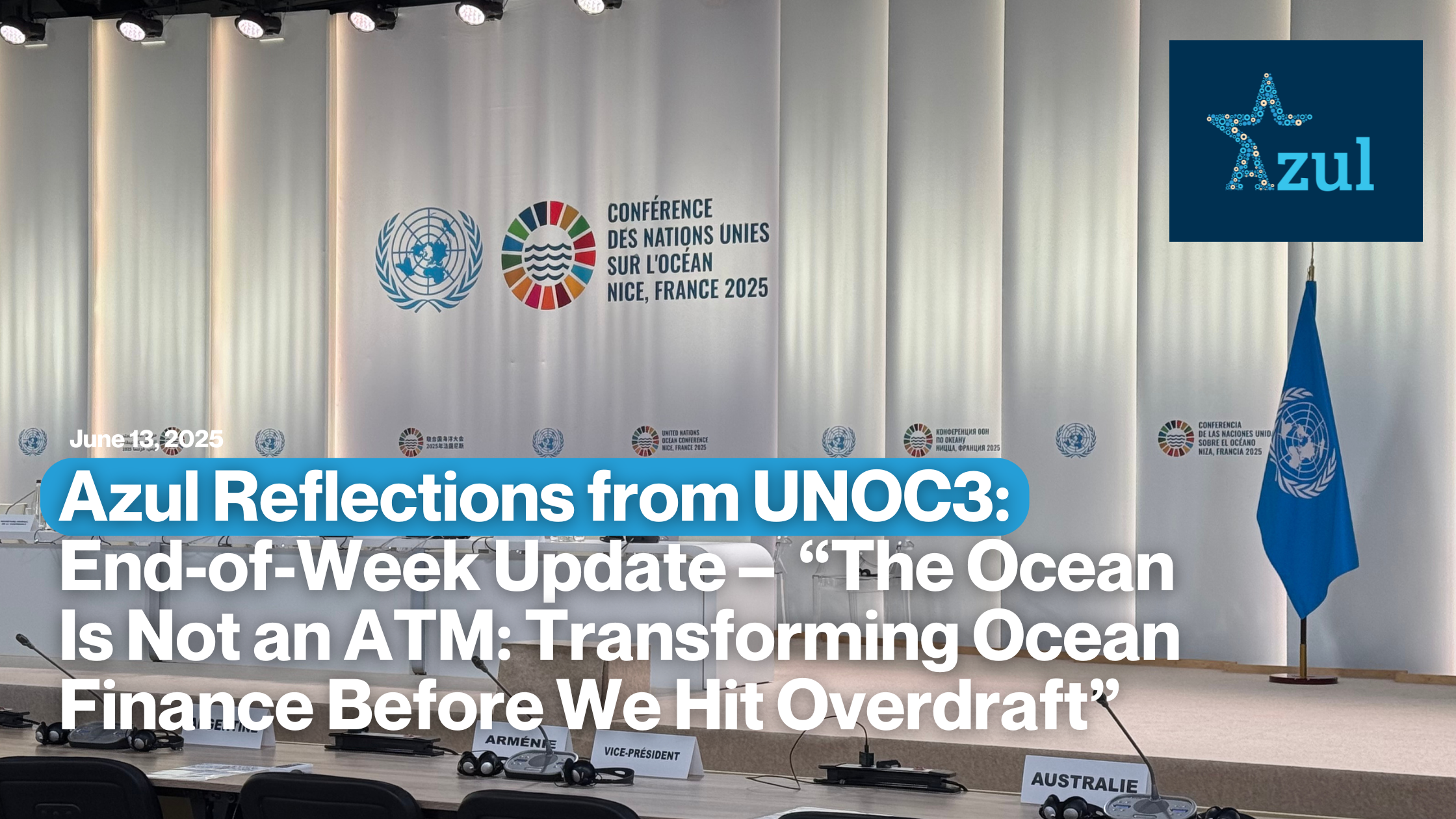
Azul Reflections from UNOC3: End-of-week Updates – “The Ocean Is Not an ATM: Transforming Ocean Finance Before We Hit Overdraft”
RELATED ARTICLES
• Day 1 Reflections from UNOC3: “The Ocean Turns Blue Without the Stars and Stripes”
• Mid-week Reflections from UNOC3: “Counting Fish to Catch Cash? Rethinking Ocean Finance Before It’s Too Late”
As UNOC3 comes to a close, the mood in the corridors is hopeful, the energy is buzzing, and treaties are taking shape. Now we must fund them. From the High Seas to coastlines and communities affected by plastic pollution, the ocean is no longer asking for handshakes; it’s asking for structural change.
This past week, momentum gathered behind the BBNJ Agreement, also known as the High Seas Treaty, with an accelerating push for ratification and implementation. However, as many delegations made clear, implementation will falter without financing that is not just adequate, but financing that empowers, not burdens; that restores, rather than exploits.
The OECD’s Ocean Economy to 2050 report sets the economic stage clearly: if the ocean economy were a country, it would rank fifth globally in GDP terms, having doubled in real value from USD 1.3 trillion in 1995 to USD 2.6 trillion by 2020 (OECD, 2025). Yet, this growth came overwhelmingly from activities, such as offshore oil and gas and mass tourism – industries that have high output but disproportionate ecological footprints and limited employment benefits. Between 1995 and 2020, marine and coastal tourism dominated job creation, while fossil fuel sectors produced much of the value with relatively few workers.
More than 75% of that growth came from Asia-Pacific countries, with Eastern Asia alone responsible for 56%. The dominance of high-income countries in ocean value has declined, but the regulatory frameworks needed to sustain the ocean economy, especially in lower-income nations, haven’t caught up. As the OECD notes, harmful subsidies persist, deep-sea ecosystems remain unmapped, and productivity is increasingly divorced from innovation, relying on outdated capital rather than digital or ecological transformation.
This is why the BBNJ Agreement must be financed not through fragmented aid but through structural support: sustained funding, community-rooted capacity building, and equitable access to marine science and technology. The agreement’s entry into force can only be meaningful if it creates new leadership opportunities for Small Island Developing States (SIDS), Least Developed Countries (LDCs), and the Global South – not new obligations without support.
Meanwhile, the Global Plastics Treaty looms large. But here’s the truth no one should gloss over: we cannot recycle our way out of this mess. Finance must shift from cleaning up to slowing down – specifically, the production of virgin plastics and the expansion of petrochemicals. The OECD’s data affirms that the ocean is already threatened by climate change and overextraction.
Relying on ocean-based solutions alone ignores the land-based drivers of collapse. The Plastics Treaty must have teeth, not just in terms of waste control, but in tackling the global production engine that turns oil into plastic packaging and pollution.
The Nice Declaration also made waves this week when more than 90 governments worldwide reaffirmed their commitment to an effective and ambitious Global Plastics Treaty. The new declaration calls for legally binding obligations to phase out the most problematic plastic products and chemicals of concern in plastic products, as well as to improve the design of plastic products. More importantly, it also makes clear that voluntary measures will not be sufficient to address the challenges of plastic pollution adequately. That vision of restraint, precaution, and care, not just expansion, is exactly what this next chapter of ocean finance must be built on.
So let us be clear: conservation is not a luxury. It is not a moral bonus. It is the most rational economic strategy available. Do you want long-term revenue? Stop degrading the asset base. The numbers speak: conservation sustains value. Extraction erodes it.
We can no longer treat the ocean as an ATM machine swiping carbon and biodiversity until the account runs dry. If we are entering a new era of ocean governance, it must be backed by a new theory of value, one that does not confuse growth with health, nor expansion with equity.
UNOC 2025 marks the page-turn. Whether the story ahead is one of recovery or regret depends entirely on what and who we choose to fund.
RELATED ARTICLES
• Day 1 Reflections from UNOC3: “The Ocean Turns Blue Without the Stars and Stripes”
• Mid-week Reflections from UNOC3: “Counting Fish to Catch Cash? Rethinking Ocean Finance Before It’s Too Late”