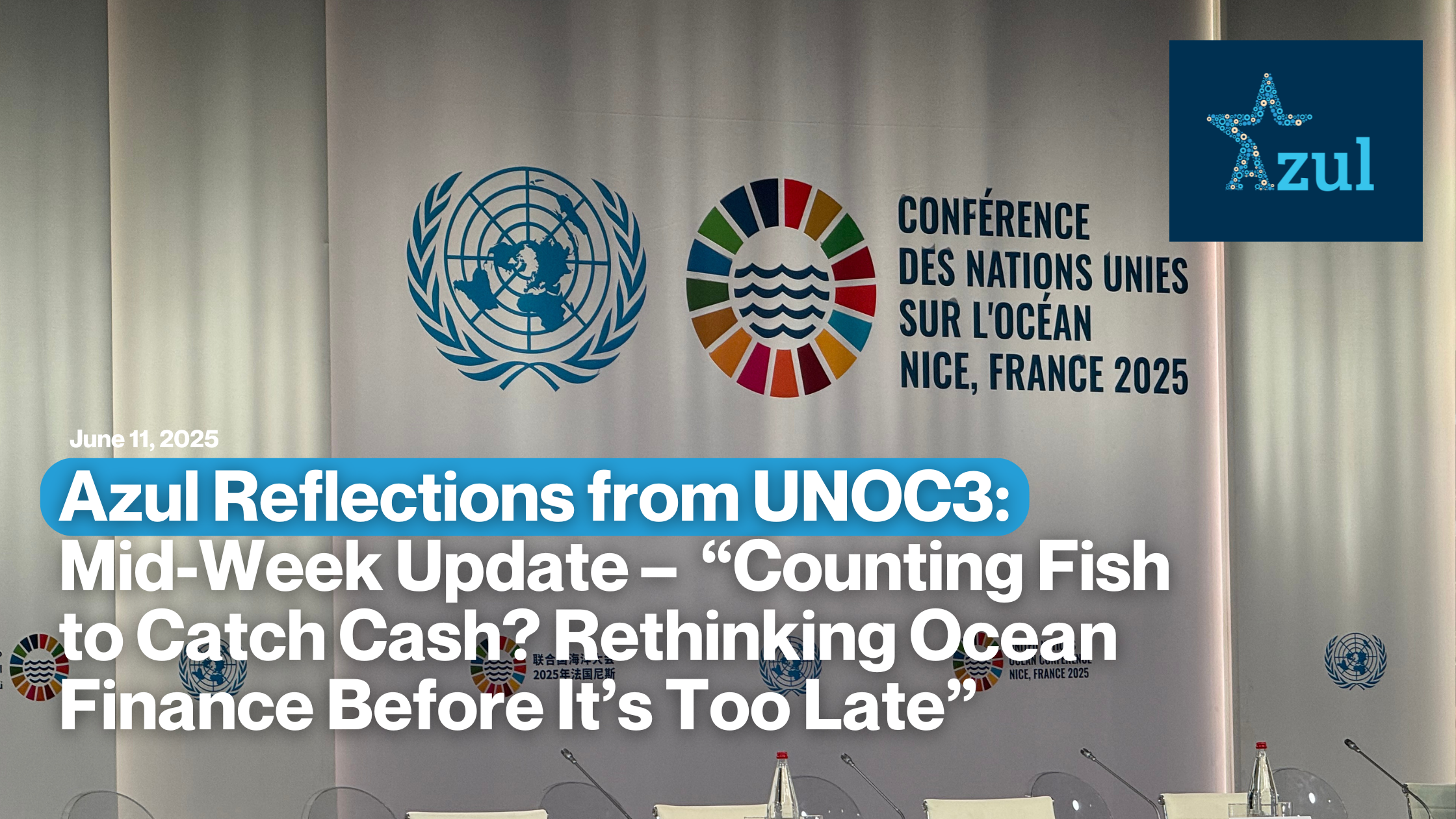
Azul Reflections from UNOC3: Mid-week Updates: “Counting Fish to Catch Cash? Rethinking Ocean Finance Before It’s Too Late”
RELATED ARTICLES
• Day 1 Reflections from UNOC3: “The Ocean Turns Blue Without the Stars and Stripes”
• End-of-week Reflections from UNOC3: “The Ocean Is Not an ATM: Transforming Ocean Finance Before We Hit Overdraft”
As world leaders gather at the Third United Nations Ocean Conference, a pressing contradiction defines the moment: bold new treaties like the BBNJ Agreement and the Plastics Treaty promise a more sustainable ocean future, yet the financial narratives underpinning them still cling to extractive logic. Biodiversity is framed as “untapped value,” marine life as “natural capital,” and governance instruments are pitched not as planetary safeguards but as tools to enable more efficient resource use. This is the language of blue growth, sanitized, technocratic, and dangerous.
The BBNJ Agreement, a landmark in international law, runs the risk of remaining largely symbolic without implementation mechanisms that address real asymmetries in power, knowledge, and capacity. Financing must not follow the old development pathways that deliver conditional aid or isolated grants. Instead, it must target community-based knowledge systems, regionally anchored capacity-building, and technology transfer that is reciprocal, not extractive. SIDS, coastal states, and the broader Global South do not need permission to lead—they need the political will from the Global North and material space to do so on their own terms.
Yet organizations with global economic mandates continue to reinforce outdated notions of “exploitation” as a normative objective for marine resources. This terminology, cloaked in ambiguity, creates space for overfishing, industrial expansion, and unchecked commodification under the pretense of sustainable management. In truth, we do not possess the regulatory or scientific infrastructure to responsibly “exploit” vast swaths of ocean biodiversity. To enshrine that term into treaties is to commit to risk without the capacity to mitigate it.
As long as “exploitation” remains the default framework, protection will be treated as the exception. That’s why more than 100 organizations worldwide, including Azul, have joined a movement in support of the Protection Principle, which would require that ocean protection takes precedence over exploitation. With the Protection Principle, ocean protection would become the rule rather than the exception.
The Plastics Treaty faces similar contradictions. If it focuses solely on downstream pollution or waste control, it will fail to address the production systems that generate plastic at scale. What is needed is a financing model that supports upstream reduction, zero waste, and localized innovation, especially in countries currently forced to manage the byproducts of a global overproduction they did not choose. Without attention to production sovereignty and a just transition, the treaty risks becoming a technocratic fix for a structural problem.
These concerns are echoed in the Nice Declaration issued by more than 90 governments around the world on the second day of the UNOC. The Declaration reaffirms the signing Members’ commitment and calls for an effective and ambitious Global Plastics Treaty, raising the alarm on the urgent need for an effective treaty. The new declaration calls for legally binding obligations to phase out the most problematic plastic products and chemicals of concern in plastic products, and improve plastic products. It also makes clear that voluntary measures will not be enough to adequately address the challenges of plastic pollution.
This is the kind of paradigm shift both the BBNJ Agreement and the Plastics Treaty require if they are to be instruments of justice, not just management.
UNCLOS laid the legal foundation, but the task now is to build governance capable of repair, not just regulation. The ocean must no longer be financed by what can be taken from it, but by what must be restored within it. Conservation is not a sunk cost. It is the only viable strategy left for ensuring ocean health, human resilience, and equitable development.
The decisions made at this conference, and in the months ahead, will determine whether multilateralism becomes a vehicle for transformative ocean governance or simply another stage for performing sustainability while deepening inequity. We must stop counting fish to catch cash — and start investing in the systems that keep the ocean alive.
RELATED ARTICLES
• Day 1 Reflections from UNOC3: “The Ocean Turns Blue Without the Stars and Stripes”
• End-of-week Reflections from UNOC3: “The Ocean Is Not an ATM: Transforming Ocean Finance Before We Hit Overdraft”